

October 9, 2026/
Gifting Shares to Family Members: Capital Gains Tax, Holdover Relief and Family...
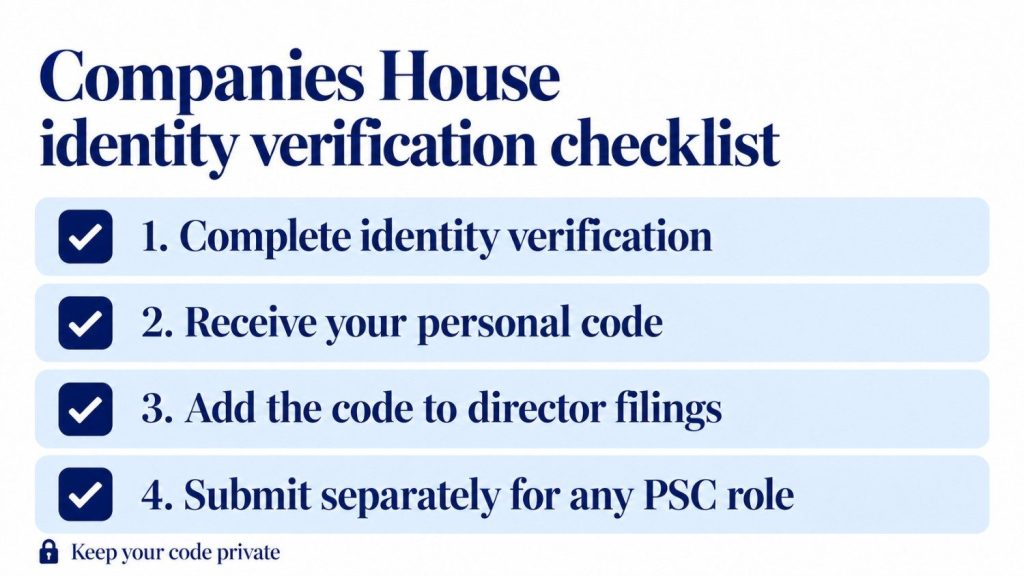
Completing your own identity check is not the only compliance question for a company board. The first prosecutions show why directors also need to address a colleague who continues acting without meeting the verification requirement.
Companies House identity verification is a legal requirement introduced from 18 November 2025, with phased deadlines for existing roles. Directors must meet the requirements applicable to their appointment, while people with significant control (PSCs) have separate submission obligations. Companies House verification guidance
The Insolvency Service secured convictions against three directors at City of London Magistrates’ Court on 16 September 2026. Companies House and the Insolvency Service announced the outcome the following day.
Two directors—Jill White and Modinat Banjo—continued acting without completing identity verification. Their activities included signing company accounts; White also participated in board-level decisions.
The third director, Marc Dillon, had verified his identity. His prosecution concerned failing to take reasonable steps to prevent his unverified co-director, White, from continuing to act.
All three were also convicted over late confirmation statements. Both previously unverified directors completed verification before the hearing, but that did not prevent conviction for the earlier conduct. These are enforcement cases under existing requirements, not a new rule introduced in September. Official prosecution announcement
New directors have been required to verify before acting since 18 November 2025. Existing directors fall within a 12-month transition linked to their company’s next confirmation statement. Companies House and Insolvency Service announcement
Verification and providing the personal code for the relevant role are distinct steps:
Role | Required action |
Existing director | Provide your Companies House personal code in the company’s next confirmation statement. Do this for each company where you are a director. |
Director of a new company | Provide the personal code as part of the incorporation filing. |
Existing PSC who is also a director of that company | Submit the code separately for the PSC role within 14 days starting the day after the confirmation statement date. Early filing does not move this window. |
Existing PSC who is not a director of that company | Submit the code during the first 14 days of your birth month in the applicable transition period. |
Person becoming a PSC after 18 November 2025 | Provide the code when added to the register or within 14 days of being added. |
Check the PSC’s recorded dates rather than assuming the director deadline covers both roles. GOV.UK: when you need to verify
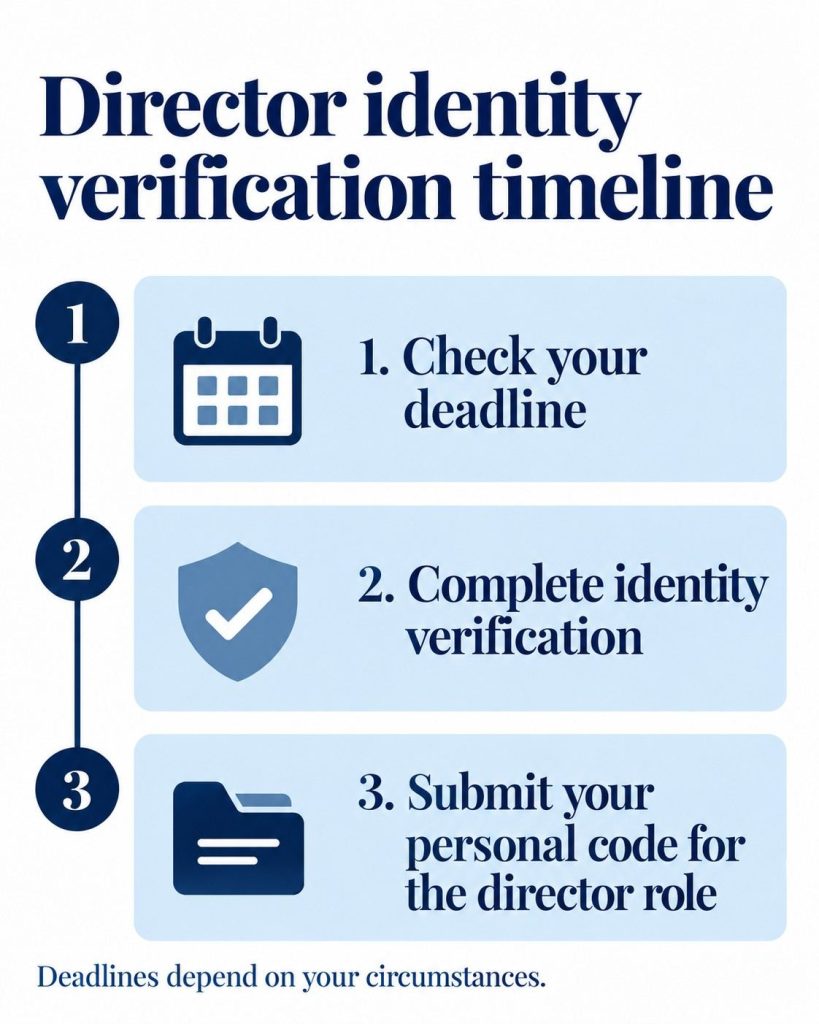
You can verify directly through Companies House free of charge, or use an Authorised Corporate Service Provider (ACSP). Official verification options
The online route uses GOV.UK One Login. Suitable photo identification includes a biometric passport or UK photocard driving licence. Alternative routes may be available, depending on your circumstances.
If asking an accountant or solicitor to carry out verification, confirm that they are registered as an ACSP. Being an accountant does not, by itself, establish that authorisation. GOV.UK: verify your identity for Companies House
Gifting Shares to Family Members: Capital Gains Tax, Holdover Relief and Family...

Sole Traders and Landlords Earning Over £30,000 Must Prepare for April 2027:...

SSAS Pension: Tax Benefits, Property Investment and Rules for Directors Home Blogs...

Business Property Relief: What the £2.5m Cap Means for You Home Blogs...
Business & Tax News and Developments September 2026 Home News Business &...

Right to Work Checks Change on 1 October 2026: What Employers Must...
A useful compliance record should answer three questions: who needs to act, what remains outstanding, and when must it be completed?
For owner-managed businesses, the practical risk is often an unfinished handover. A director believes the identity check is complete, the accountant is waiting for a personal code, and nobody has allocated the separate PSC submission.
For example, consider a shareholder-director who sends their code to the accountant for the confirmation statement. The sensible next question is not simply “Have you verified?” but “Who is handling your PSC submission, and has it been accepted?”
We recommend keeping a short, secure checklist for each company:
This is a recommended management control, not a suggestion that preparing accounts creates a separate verification deadline.
Where a deadline has already passed, obtain advice promptly about verification, outstanding filings and whether the individual may continue acting. Do not assume a reminder email alone resolves the issue.
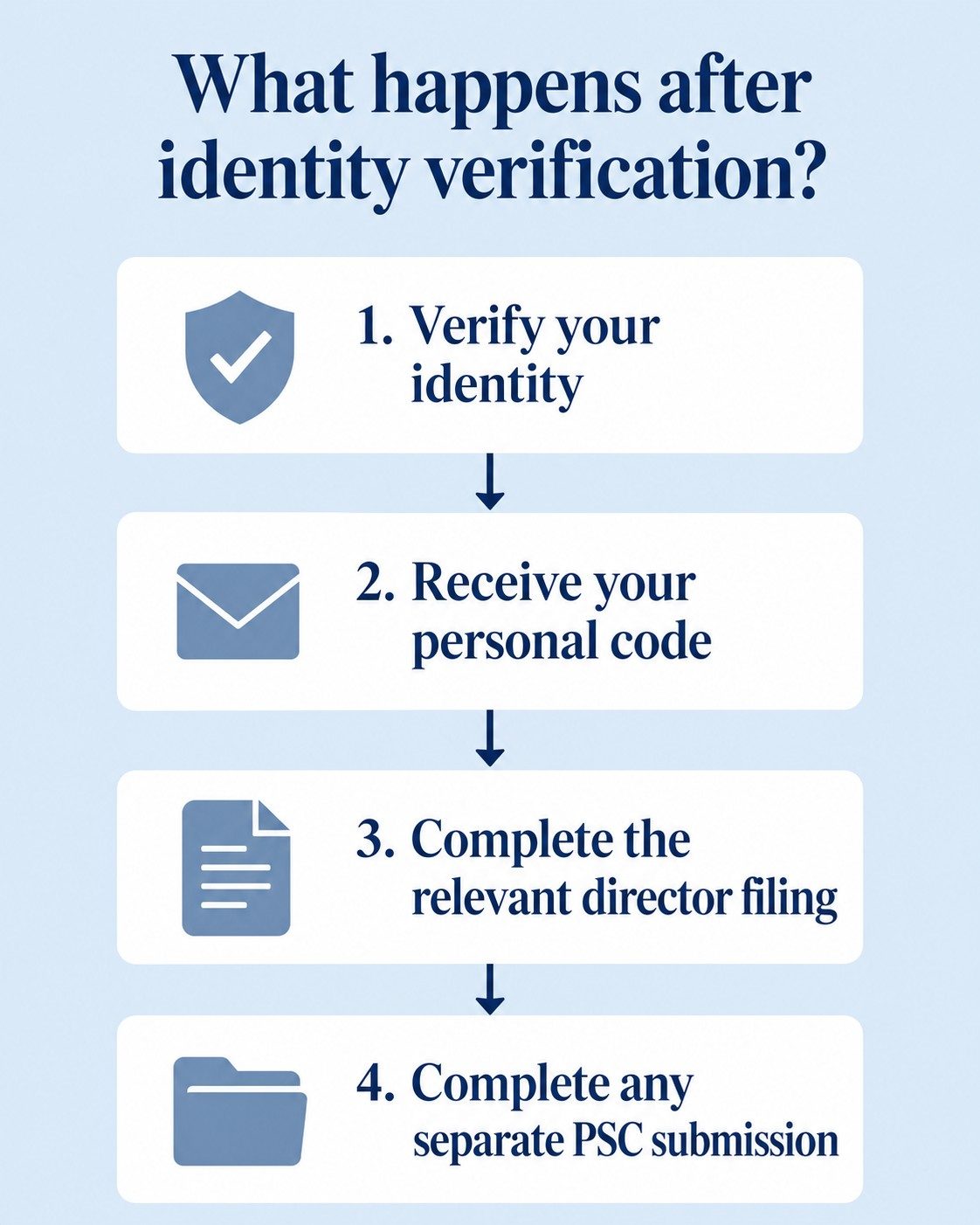
The practical lesson is to manage verification as a company-wide responsibility, with clear ownership of each outstanding step. A personal check, a director filing and a PSC submission should not be treated as interchangeable.
Review your records now, identify any gaps and address them before the next filing becomes urgent.
If you are unsure which deadline applies, whether a submission remains outstanding or how to address a missed requirement, speak to Naail & Co. We can help you review the position and identify the appropriate next steps.
Get in touch with Naail & Co to book your free initial consultation.
Monday – Friday
9:00 am – 5:30 pm
Companies House identity verification confirms that someone involved in running or controlling a company is who they claim to be. It forms part of reforms designed to improve the reliability of the UK company register and tackle misuse of companies. Mandatory requirements began on 18 November 2025, with phased deadlines for existing directors and people with significant control (PSCs). GOV.UK guidance
You complete an identity check through GOV.UK One Login or a Companies House Authorised Corporate Service Provider (ACSP). You then provide your Companies House personal code for the relevant company roles. Completing the identity check does not automatically complete every submission: director and PSC requirements must be addressed separately, even when the same person holds both roles. Verification process and role-specific requirements.
New directors must verify before acting, while existing directors must meet the transitional requirement linked to their company’s next confirmation statement. Do not assume the end of the transition period is your individual deadline. Check the relevant company dates early and arrange verification before the filing becomes urgent. Companies House and Insolvency Service guidance
Yes. If you are both a director and a PSC of the same company, you must provide your personal code separately for each role. For existing roles, the director submission accompanies the confirmation statement; the PSC submission falls within the 14 days starting the day after the confirmation statement date. Filing the statement early does not change that PSC window. GOV.UK deadline guidance
Direct identity verification through Companies House is free. You can also use an ACSP, such as an authorised accountant or solicitor, whose charges should be confirmed before proceeding. Ask whether any quoted fee covers only the identity check or also assistance with the relevant submissions. This helps you compare the scope of support rather than the headline price alone. Official verification options
Yes. Continuing to act as a director without meeting the applicable verification requirement can lead to prosecution. The September 2026 cases included directors who signed company accounts while unverified. Completing verification later did not prevent their convictions. If your deadline has passed, seek prompt advice about correcting the position and whether you may continue acting. Official prosecution announcement
Your own verification does not remove responsibilities concerning an unverified co-director. In the first prosecutions, a verified director was convicted after failing to take reasonable steps to prevent his unverified colleague from continuing to act. Review outstanding cases, document the action taken and obtain advice where necessary; do not treat another director’s non-compliance as solely their personal concern. Insolvency Service announcement
Yes. The online service accepts biometric passports from other countries and certain alternative documents, including UK photocard driving licences. Other routes may be available depending on your circumstances. An ACSP can also carry out verification using suitable evidence. Check the available route before starting, particularly if you live overseas or your identification documents have expired. GOV.UK identification requirements
No. Companies House identity verification concerns company-register compliance; it does not complete HMRC registrations, submit tax returns or settle tax liabilities. Keep verification, confirmation statements and tax obligations as separate items in your compliance calendar. From an accounting perspective, the practical safeguard is to record who is responsible for each task and retain evidence of completion. Companies House verification guidance
Yes. An accountant registered with Companies House as an ACSP can verify your identity on your behalf. Confirm their authorisation before instructing them. You can also ask your accountant to review relevant deadlines, identify outstanding director or PSC submissions and agree who will handle each step. A clear division of responsibilities helps prevent an otherwise completed identity check from leaving filings unfinished. GOV.UK guidance on authorised agents


Alphabet Shares in a Limited Company: Tax Rules, Risks and Practical Planning Home Blogs Alphabet Shares in a Limited Company:...
Companies House Identity Verification: First Convictions Warn Directors Home Blogs Companies House Identity Verification: First Convictions Warn Directors Updated on 21...

Alphabet Shares vs Dividend Waivers: Why the Structure Matters Home Blogs Alphabet Shares vs Dividend Waivers: Why the Structure Matters...


Subscribe to our newsletter to receive our weekly feed.

69-71 Lambeth Walk London SE11 6DX
Monday – Friday 9:00 am – 5:30 pm
Subscribe to our newsletter
Follow us
Download from
Services
DROP US A LINE
Copyright 2024 Naail & Co | Designed by Orion Global Consulting. | Naail & Co is the trading name of Naail & Co Ltd | Company registration number 08606377 | VAT registration number 170 3380 31


