

October 9, 2026/
Gifting Shares to Family Members: Capital Gains Tax, Holdover Relief and Family...

For owner-managed companies, paying different levels of dividends to different shareholders can appear straightforward. In practice, however, the legal structure behind those payments matters considerably.
Two commonly discussed approaches are alphabet shares and dividend waivers. Both can result in different shareholders receiving different dividend amounts, but they achieve this in fundamentally different ways.
Alphabet shares can provide a more flexible and sustainable framework because different classes of shares may have separate dividend rights. However, they are not an automatic solution to the tax risks associated with dividend waivers. HMRC’s settlements legislation can potentially apply to either arrangement where income is deliberately diverted to another person through an element of bounty.
Alphabet shares generally provide greater flexibility than dividend waivers because a company can create separate share classes and declare different dividends on each class, provided its articles and share rights permit this. However, alphabet shares do not automatically avoid HMRC’s settlements legislation: the commercial purpose, share rights, relationship between shareholders and economic substance of the arrangement must all be considered.
A dividend waiver occurs when a shareholder gives up their entitlement to a dividend so that they do not receive a distribution that would otherwise be payable to them.
This can have the effect of allowing more profits to be distributed to other shareholders.
For example, consider a company owned by a husband and wife. If the husband is a higher-rate taxpayer and waives his dividend while the company pays a larger dividend to his lower-taxed wife, the overall family tax liability may fall.
That does not automatically make the waiver ineffective. However, it creates an obvious question under the settlements legislation in Part 5, Chapter 5 of the Income Tax (Trading and Other Income) Act 2005 (ITTOIA 2005).
HMRC specifically considers whether a waiver contains an element of bounty — broadly, whether one person has gratuitously given up income or value so that somebody else benefits.
HMRC identifies several warning signs, including:
This is why dividend planning should be considered in substance rather than merely as a company secretarial exercise.

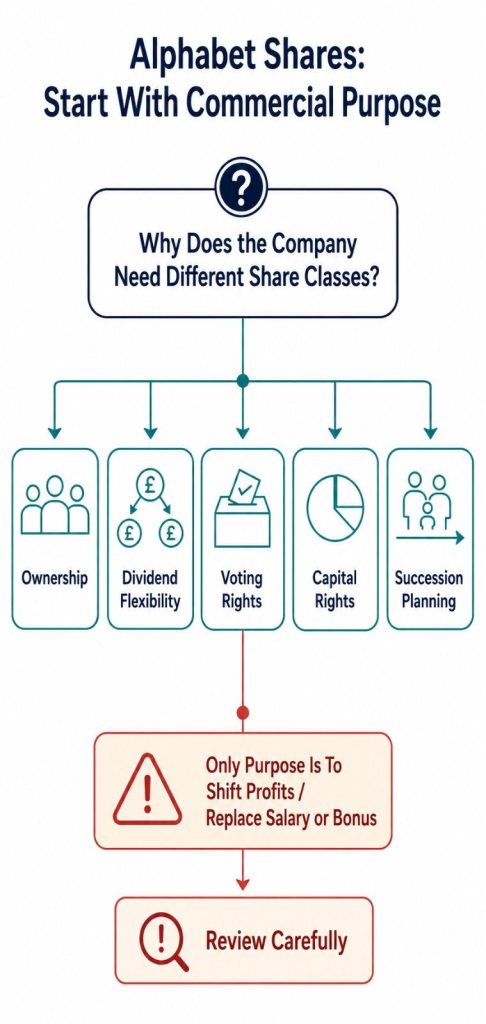
An alphabet share structure usually divides ordinary share capital into separate classes, such as A ordinary shares, B ordinary shares and C ordinary shares.
Provided the company’s articles and the rights attaching to each class are properly drafted, the directors may be able to declare:
No shareholder needs to waive a dividend because each class has its own dividend entitlement under the company’s constitutional arrangements.
That distinction can make alphabet shares substantially easier to administer where a company has a genuine and continuing need for dividend flexibility.
But there is an important warning.
Creating different share classes does not, by itself, remove the settlements legislation risk.
HMRC’s own guidance specifically identifies differing classes of shares that enable dividends to be paid only to shareholders subject to lower rates of tax as a factor that may indicate a settlement.
The correct question is therefore not simply:
“Do we have alphabet shares?”
It is:
“Why do these shareholders hold these shares, what rights do the shares carry, and would the arrangement make commercial sense outside the family relationship?”
The settlements legislation is deliberately broad.
A “settlement” can include an arrangement, agreement, disposition or transfer of assets. A conventional trust is not required.
Where there is an element of bounty and the person who created the settlement retains an interest in it, ITTOIA 2005, s624 can attribute the income back to that person for income tax purposes.
HMRC’s guidance specifically flags arrangements involving:
This means that neither a dividend waiver nor an alphabet share structure should be implemented purely by looking at the immediate dividend tax saving.
The wider commercial and economic arrangement matters.


One of the most important cases in this area remains Jones v Garnett [2007], commonly known as the Arctic Systems case.
Mr and Mrs Jones each held an ordinary share in their company. Mr Jones generated most of the company’s income, while both spouses received relatively small salaries and substantial dividends.
The House of Lords accepted that the arrangement contained sufficient bounty to constitute a settlement. Crucially, however, the taxpayer still won because the spouse exemption applied.
Under ITTOIA 2005, s626, certain outright gifts between spouses or civil partners are excluded from the settlements charge, provided the property given is not wholly or substantially a right to income.
Mrs Jones held a genuine ordinary share carrying more than merely an entitlement to dividends. This distinction proved critical.
For alphabet share planning, the practical lesson is significant.
Where reliance is placed on the spouse exemption, shares carrying genuine capital and other substantive rights are generally much easier to defend than so-called “thin shares” designed principally to provide a dividend stream.
Simply issuing a family member a share that is effectively little more than a right to income can materially increase the settlements legislation risk.
Gifting Shares to Family Members: Capital Gains Tax, Holdover Relief and Family...

Sole Traders and Landlords Earning Over £30,000 Must Prepare for April 2027:...

SSAS Pension: Tax Benefits, Property Investment and Rules for Directors Home Blogs...

Business Property Relief: What the £2.5m Cap Means for You Home Blogs...
Business & Tax News and Developments September 2026 Home News Business &...

Right to Work Checks Change on 1 October 2026: What Employers Must...
Buck v HMRC [2008] SpC 716 demonstrates how aggressive dividend arrangements can fail.
Mr Buck owned 9,999 shares while his wife owned just one. He waived his dividend entitlement, allowing very substantial dividends to be paid to his wife despite her holding only 0.01% of the company’s shares.
The arrangement produced a return to Mrs Buck that was wholly disproportionate to her economic interest in the company.
The settlements legislation applied.
The case illustrates an important principle for family companies:
The more artificial the relationship between the shareholder’s genuine economic interest and the income received, the harder the arrangement becomes to defend.
Changing the label from a dividend waiver to an alphabet share does not cure an arrangement that remains economically artificial.


A further important authority is Donovan and McLaren v HMRC [2014] UKFTT 048 (TC). The taxpayers argued, among other things, that sufficient distributable reserves existed to pay dividends to all shareholders. That was not enough.
The tribunal concluded that the dividend waivers would not have occurred on the same terms in an arm’s-length commercial relationship and that the arrangements contained the necessary element of bounty.
This provides another important planning principle:
Having sufficient distributable reserves may help, but it does not by itself prevent the settlements legislation from applying.
Commercial substance must exist beyond the arithmetic.
Dividend waivers also create additional legal and administrative requirements.
A waiver should be properly documented and completed before the shareholder’s entitlement to the relevant dividend has crystallised.
The distinction between interim and final dividends is particularly important.
Broadly, HMRC considers that:
A purported waiver after the relevant income has already become due or been paid may instead amount to an assignment or transfer of income, potentially producing a very different tax result.
The preparation of deeds can also involve reserved legal activity in England and Wales, meaning professional advisers must consider carefully whether they are authorised to prepare the necessary legal documentation.
This additional formality is one reason why a properly established alphabet share structure can be more practical for companies requiring recurring dividend flexibility.


The importance of understanding the company’s articles was reinforced in HMRC v Peter Gould [2024] UKUT 285 (TCC).
Two brothers were entitled to substantial interim dividends from the same company. One received his dividend during the 2015/16 tax year, while the other wanted payment deferred until 2016/17, when he expected to be non-UK resident.
The Upper Tribunal considered whether payment to one shareholder created an enforceable right for the other shareholder under the company’s articles.
The case ultimately turned on the particular arrangements between the shareholders, including the application of the Duomatic principle and the effectiveness of the arrangements modifying their rights.
For owner-managed companies, the wider lesson is straightforward:
You cannot assume that shareholders holding the same class of shares can simply receive the same dividend at different times without considering the legal rights created by the articles and the dividend declaration.
Separate share classes can make differential dividend arrangements structurally clearer because dividends may be declared independently on each class where the company’s constitution permits it.
Income tax is not the only issue.
Dividend waivers also need to be considered under the inheritance tax rules.
IHTA 1984, s15 provides specific protection where a person waives a dividend within the 12 months before the right to that dividend accrues. In those circumstances, the waiver does not of itself constitute a transfer of value.
HMRC nevertheless makes clear that the protection has limited scope. If a waiver forms part of a wider series of arrangements designed to transfer value, the overall transaction may require separate consideration.
This is more precise than assuming that every dividend waiver lasting less than 12 months is automatically free from IHT consequences.
Alphabet shares avoid the need to execute repeated dividend waivers, but they should not be described as inherently IHT-free. Creating, gifting or altering shares can itself have tax and valuation consequences, particularly where value is deliberately shifted between shareholders.
Any family-company restructuring should therefore consider income tax, capital gains tax and inheritance tax together, rather than examining the dividend position in isolation.

Issue | Alphabet Shares | Dividend Waivers |
Dividend flexibility | High, where properly supported by the articles | More limited and requires individual waivers |
Separate dividend classes | Yes | No |
Recurring documentation | Usually lower once correctly established | Waivers need careful documentation |
Settlements legislation risk | Still potentially applies | Still potentially applies |
Spouse exemption | Potentially available where conditions are satisfied | Generally problematic where the settlement consists only of waived income |
Company law considerations | Articles and class rights must be correct | Timing and legal validity of waiver are critical |
IHT considerations | Share creation/transfers and value shifting must be reviewed | IHTA 1984, s15 may provide protection in qualifying cases |
Long-term flexibility | Generally stronger | Often less practical for repeated differential dividends |
Professional input | Tax and company-law drafting should be coordinated | Legal input may be required for waiver documentation |

For companies with a genuine commercial requirement to vary dividends between shareholders, alphabet shares often provide a cleaner framework.
Potential advantages include:
However, one commonly repeated argument should be treated with caution: alphabet shares are not automatically stronger merely because differential treatment is written into the articles.
If the real arrangement is simply designed to divert profits generated by one person to a lower-taxed family member, HMRC can still examine the underlying substance.
In practice, problems often arise because tax planning begins with the desired dividend rather than with the underlying share structure.
A director decides that £40,000 should go to one spouse and £10,000 to another, and only afterwards asks how the company can legally produce that result.
That is the wrong order.
The better approach is to review:
The company can then determine its dividend policy within that structure.
This distinction matters because alphabet shares are a company ownership structure, not simply a year-end tax-saving device.
Where an existing company intends to convert ordinary shares into alphabet shares, advisers should also review the articles, shareholder rights, Companies House requirements, potential employment-related securities issues where relevant, and the wider tax consequences before implementing the change.
Dividend waivers remain legally and commercially valid in appropriate circumstances. They should not be regarded as inherently unacceptable from a tax perspective.
However, repeated waivers designed primarily to redirect dividends between family members can create significant settlements legislation concerns and additional legal administration.
For companies that genuinely require continuing flexibility over dividends, a properly designed alphabet share structure will often provide a more coherent long-term framework.
The crucial words are “properly designed”.
The structure must be supported by appropriate articles, genuine shareholder rights, correct company procedures and a defensible commercial rationale. Alphabet shares should never be treated as a mechanism that automatically sidesteps HMRC’s settlements legislation.
The difference between effective dividend planning and an HMRC challenge often lies in the underlying facts rather than the name attached to the arrangement.
Before introducing alphabet shares, changing existing share rights or using dividend waivers, companies should consider the company law, income tax, settlements legislation, CGT and inheritance tax consequences together.
A structure that saves dividend tax today but creates an exposure under the settlements legislation — or an unexpected tax consequence when shares are reorganised or transferred — is not effective tax planning.
Naail & Co can review existing company share structures, advise on the tax implications of alphabet shares and dividend waivers, and help directors establish a structure appropriate to their commercial objectives.
Get in touch with Naail & Co to book your free initial consultation.
Monday – Friday
9:00 am – 5:30 pm
The main difference is that alphabet shares create separate share classes with potentially different dividend rights, while a dividend waiver involves a shareholder giving up an existing entitlement to a dividend. Alphabet shares can provide greater long-term flexibility, but both structures can be challenged under HMRC’s settlements legislation if they are used mainly to divert income to a lower-taxed shareholder without sufficient commercial substance.
Alphabet shares vs dividend waivers planning can change which shareholder receives company dividends and therefore who pays dividend tax. However, HMRC may apply the settlements legislation if the arrangement contains an element of bounty and is designed to shift income artificially. The tax treatment depends on the underlying shareholder rights, commercial rationale, relationship between the parties and whether the recipient holds a genuine economic interest in the company.
A company should consider alphabet shares vs dividend waivers when different shareholders need different dividend amounts and that flexibility is expected to continue. Alphabet shares are often more practical for recurring arrangements because separate classes can receive different dividends where the articles permit. Dividend waivers may still be suitable for isolated circumstances, but repeated waivers can create additional legal, administrative and settlements legislation risks.
Yes, alphabet shares vs dividend waivers can be used in family companies, including between spouses, but the tax position must be reviewed carefully. The spouse exemption within the settlements legislation may protect certain outright gifts of genuine shares, as illustrated by the Arctic Systems case. However, shares that are effectively only a right to income, or arrangements designed mainly to redirect dividends to a lower-taxed spouse, may remain vulnerable to HMRC challenge.
You may need to change the articles if the existing constitution does not permit separate share classes or differential dividends. For alphabet shares, the dividend, voting and capital rights of each class should be clearly defined before dividends are declared. Dividend waivers also require proper legal documentation and correct timing. Using standard articles without checking the underlying rights is a common mistake that can create both company law and tax problems.
The settlements legislation is important because HMRC can attribute income back to the person who originally provided the value or opportunity to generate that income. This can apply where alphabet shares or dividend waivers are used to divert dividends to a family member paying less tax. HMRC looks at economic substance, not just legal form, including the shareholder’s rights, contribution, commercial rationale and whether the arrangement contains an element of bounty.
The cost depends on the company’s existing share structure, articles and the complexity of the tax review. Alphabet shares may require bespoke articles, Companies House filings, board and shareholder resolutions, and professional tax advice. Dividend waivers can involve separate legal documentation each time they are used. A properly structured alphabet share arrangement may cost more initially but can be more efficient where ongoing dividend flexibility is required.
Yes, but there is no automatic exemption from HMRC scrutiny. The strongest position is where the share structure has a genuine commercial purpose, the rights are properly documented, dividends are legally declared, and the arrangement is not simply designed to shift income to a lower-taxed family member. Contemporaneous records, appropriate articles and a clear explanation of the commercial rationale can materially strengthen the company’s position if HMRC later reviews the arrangement.
Dividend waivers and alphabet shares can both have inheritance tax implications. IHTA 1984, s15 provides specific protection for certain dividend waivers made within 12 months before the right to the dividend accrues, but wider arrangements may still need review. Alphabet share restructures can also shift value between shareholders, potentially creating inheritance tax or capital gains tax consequences. The full transaction should therefore be reviewed before shares are created, transferred or varied.
The most common mistakes are implementing the structure after deciding the desired dividend, relying on standard articles, issuing “thin” shares carrying little more than income rights, failing to document the commercial rationale, and assuming alphabet shares automatically avoid the settlements legislation. Companies should review the share rights, distributable reserves, board procedures, tax consequences and shareholder relationships before paying dividends, rather than trying to correct the structure afterwards.


Alphabet Shares in a Limited Company: Tax Rules, Risks and Practical Planning Home Blogs Alphabet Shares in a Limited Company:...
Companies House Identity Verification: First Convictions Warn Directors Home Blogs Companies House Identity Verification: First Convictions Warn Directors Updated on 21...

Alphabet Shares vs Dividend Waivers: Why the Structure Matters Home Blogs Alphabet Shares vs Dividend Waivers: Why the Structure Matters...


Subscribe to our newsletter to receive our weekly feed.

69-71 Lambeth Walk London SE11 6DX
Monday – Friday 9:00 am – 5:30 pm
Subscribe to our newsletter
Follow us
Download from
Services
DROP US A LINE
Copyright 2024 Naail & Co | Designed by Orion Global Consulting. | Naail & Co is the trading name of Naail & Co Ltd | Company registration number 08606377 | VAT registration number 170 3380 31


