
Blogs Home >> MTD for Income Tax
Making Tax Digital for Income Tax is now in force. If you are self-employed, receive rental income or have both sources of income, the way you report your finances to HMRC may already have changed.
Introduced on 6 April 2026, Making Tax Digital for Income Tax is one of the most significant changes to Self Assessment in recent years. It replaces the traditional approach of reporting business and property income only through an annual tax return with a system of digital record-keeping and regular quarterly updates.
The rules are being introduced gradually, bringing more sole traders and landlords into the system in April 2027 and April 2028.
This comprehensive guide from Naail & Co Chartered Certified Accountants & Tax Advisors explains who must comply, how qualifying income is calculated, what records you need, when submissions are due and how to prepare for HMRC’s requirements.
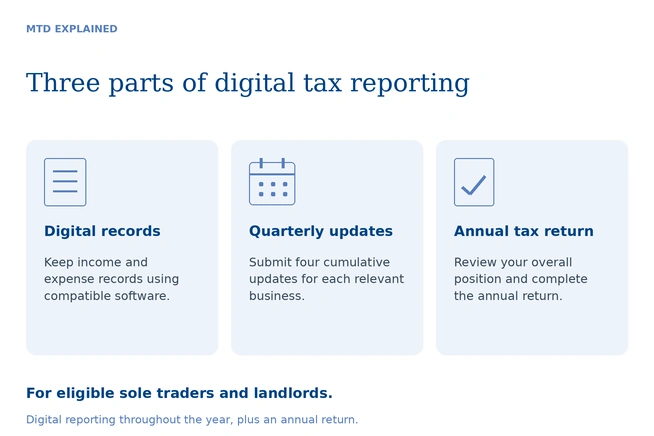
Making Tax Digital for Income Tax (MTD for Income Tax) is HMRC’s digital system for reporting self-employment and property income. Individuals within the regime must use compatible software to maintain digital records, submit four quarterly updates and complete an annual tax return.
It applies to eligible sole traders and landlords whose combined qualifying income exceeds the relevant threshold. The purpose is to make tax reporting more regular, improve record accuracy and give taxpayers a clearer view of their financial position throughout the year.
MTD changes how and when financial information is reported to HMRC. It does not introduce a new Income Tax or require Income Tax to be paid every quarter.
MTD for Income Tax at a Glance
| Key requirement | What you need to know |
|---|---|
| Started | 6 April 2026 |
| First income threshold | More than £50,000 |
| April 2027 threshold | More than £30,000 |
| April 2028 threshold | More than £20,000 |
| Who is primarily affected? | Eligible sole traders and landlords |
| Qualifying income | Combined gross self-employment and property income, before expenses |
| Digital records | Mandatory for relevant income and expenses |
| Quarterly updates | Four cumulative updates per tax year |
| First quarterly filing deadline | 7 August |
| Other quarterly deadlines | 7 November, 7 February and 7 May |
| Annual tax return | Required through compatible software |
| Annual filing deadline | 31 January following the tax year |
| Quarterly Income Tax payments | Not introduced by MTD |
| Accountant required? | Not compulsory, but professional assistance is permitted |
“`
Not everyone who submits a Self Assessment tax return is required to use MTD for Income Tax. Eligibility depends on income sources, qualifying income, the relevant tax year and any applicable exemptions.
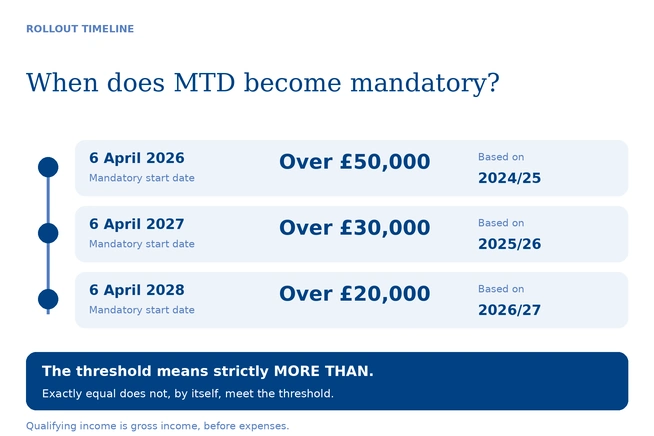
HMRC is introducing Making Tax Digital for Income Tax in three main stages.
| Mandatory start date | Qualifying income | Tax year used to assess eligibility |
|---|---|---|
| 6 April 2026 | More than £50,000 | 2024/25 |
| 6 April 2027 | More than £30,000 | 2025/26 |
| 6 April 2028 | More than £20,000 | 2026/27 |
HMRC is introducing Making Tax Digital for Income Tax in three main stages.
The thresholds refer to qualifying income, not taxable profit.
For example, an individual with £55,000 in gross self-employment income and £30,000 in allowable business expenses may have taxable trading profits of £25,000. Nevertheless, their qualifying income for MTD purposes would generally be £55,000.
Equally, someone receiving £22,000 from self-employment and £17,000 in gross rental income has combined qualifying income of £39,000. Subject to the applicable eligibility conditions and exemptions, this would bring them into MTD from April 2027 if those amounts were reported for 2025/26.
The thresholds are strictly more than £50,000, £30,000 or £20,000. Having income exactly equal to the relevant threshold does not, by itself, meet that threshold.
HMRC generally assesses eligibility using the Self Assessment tax return for the relevant earlier tax year. However, amended returns, shorter accounting periods, ceased income sources and other special circumstances may affect the assessment.
For current eligibility criteria, see HMRC’s official MTD for Income Tax guidance.
One of the most important aspects of Making Tax Digital is understanding which income HMRC includes when deciding whether you must comply.
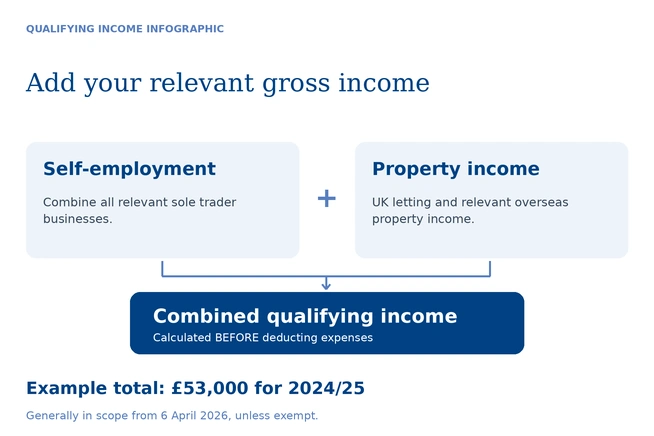
Qualifying income generally consists of your gross income from:
It is calculated before deducting business or property expenses.
Even though neither income source individually exceeds £50,000, the combined qualifying income is £53,000.
Assuming this was the qualifying income reported for 2024/25 and no exemption applies, MTD for Income Tax became mandatory from 6 April 2026.
| Income source | Gross annual income |
|---|---|
| Consultancy business | £28,000 |
| Residential rental property | £25,000 |
| Total qualifying income | £53,000 |
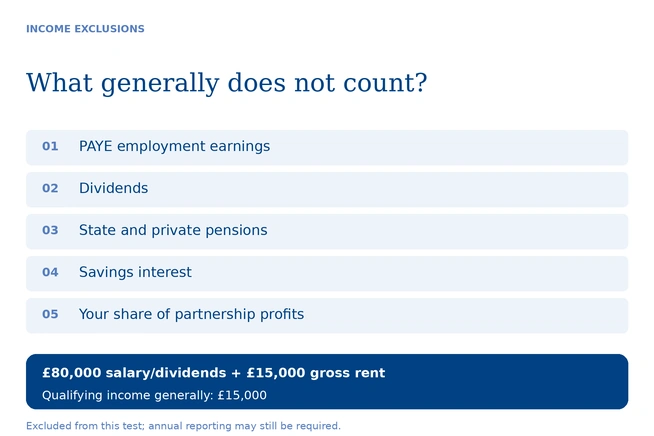
The following generally do not form part of qualifying income:
These amounts may still need to be reported on the annual tax return where applicable.
For example, a company director receiving £80,000 in salary and dividends, alongside £15,000 in gross rental income, would not normally enter MTD solely because their total personal income exceeds £50,000.
Their qualifying income for this purpose would generally be £15,000, not £95,000.
Certain categories of income, accounting periods, tax residence arrangements and relief claims require more detailed consideration.
Sole traders, freelancers, consultants, contractors and other self-employed individuals may be required to use MTD when their qualifying income exceeds the relevant threshold.
This includes individuals carrying on more than one self-employed business.
Each relevant trade generally has its own digital record-keeping and quarterly reporting requirements.
Individual landlords receiving qualifying property income may also fall within MTD.
This can include people with:
The number of properties does not determine MTD eligibility. What matters is qualifying income and the applicable rules.
For individual landlords, UK rental properties are generally treated as one UK property business for quarterly reporting purposes, rather than requiring a separate quarterly update for each property.
Foreign property income has separate record-keeping considerations.
MTD can become more complicated when someone has several businesses, rental properties or other taxable income.
For example, a taxpayer might operate a consultancy business, own jointly let property and receive investment dividends.
Some income sources count towards MTD eligibility; others affect only the annual tax calculation.
Understanding that distinction is essential.
Ordinary partnership income is not currently subject to MTD for Income Tax quarterly reporting under the individual sole trader and landlord rollout. HMRC has not yet announced the mandatory implementation date for partnerships.
Limited companies are not brought into MTD for Income Tax because of their Corporation Tax profits.
However, company directors and partners may still have personal qualifying income from separate self-employment or property activities.
Residence status can affect which income is included when assessing MTD eligibility.
For UK tax residents, both UK and relevant overseas property income may count.
For non-UK residents, the calculation generally focuses on UK property income and self-employment income declared on the UK Self Assessment return.
Certain taxpayers with overseas income or residence-related supplementary pages may qualify for specific transitional exemptions. These should be checked individually rather than assuming all non-residents are exempt.
Taxpayers within MTD must create and maintain digital records of relevant income and expenses.
Digital records generally include:
For sole traders, this may cover sales income, purchases, professional expenses, travel, subcontractor costs and other business transactions.
For landlords, it may include rental receipts, repairs, agent fees, property expenses and relevant finance costs.
Taxpayers must continue to retain supporting documentation, such as invoices and bank statements, in accordance with normal tax record-keeping requirements.
Simply having a bank feed does not mean your books are accurate. Transactions must still be correctly identified, categorised and reviewed.
MTD requires regular submissions of income and expense summaries to HMRC.
A quarterly update is not a complete tax return and does not normally involve calculating the final tax liability.
The updates are cumulative, meaning each submission covers the tax year to date rather than only the latest three months.
After the tax year ends, taxpayers must review their accounting information, make necessary adjustments, add other taxable income and gains, claim relevant reliefs and submit an annual tax return through compatible software.
The annual tax return remains an essential part of the MTD process.
It is important not to confuse quarterly reporting with finalising your tax affairs.
| Reporting period | Submission deadline |
|---|---|
| 6 April – 5 July | 7 August |
| 6 April – 5 October | 7 November |
| 6 April – 5 January | 7 February |
| 6 April – 5 April | 7 May |
Taxpayers may use calendar update periods where appropriate.
These run to:
Importantly, the filing deadlines remain 7 August, 7 November, 7 February and 7 May.
Your reporting-period selection should be checked before submitting the first quarterly update. It cannot simply be changed partway through a tax year after an update has been submitted.
Yes.
For example, your second quarterly update normally includes income and expenses from the start of the relevant tax year through to 5 October, rather than only transactions from July to October.
Similarly, the third and fourth updates include cumulative financial information.
This allows corrections to earlier digital records to be reflected in later quarterly submissions without automatically having to resubmit each previous update.
No.
MTD does not introduce a requirement to pay Income Tax every three months.
Taxpayers must still comply with normal Self Assessment payment obligations, including payments on account where applicable.
Quarterly updates can assist with tax forecasting, but the figures submitted do not automatically establish the final amount of Income Tax payable.
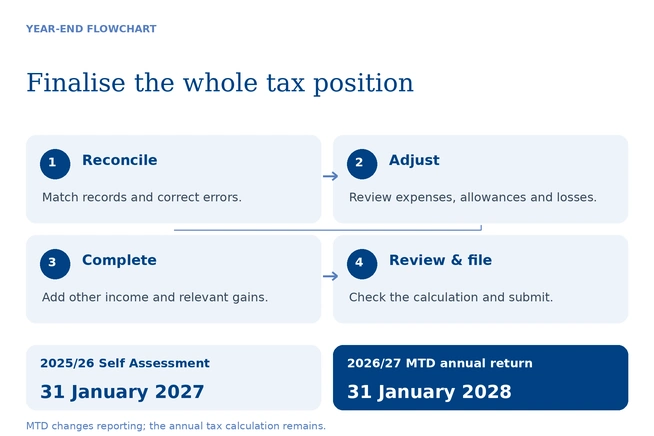
The annual return is where the overall tax position is finalised.
Before submitting it, taxpayers and their accountants may need to:
For the first mandatory MTD year, 2026/27, the annual tax return must be submitted by 31 January 2028.
Taxpayers entering MTD in April 2026 must also complete their preceding 2025/26 Self Assessment tax return by the normal deadline of 31 January 2027.
MTD changes the reporting method. It does not remove the need for proper year-end tax calculations and professional judgement.
HMRC requires MTD-compatible software to maintain digital records, submit quarterly updates and complete the annual tax return.
There are different ways to meet these requirements.
| Software approach | How it works | May suit |
|---|---|---|
| Cloud accounting software | Records transactions and supports MTD submissions | Sole traders and businesses needing ongoing bookkeeping |
| Property accounting software | Records rental transactions and property expenses | Landlords with relevant property income |
| Spreadsheet and bridging software | Connects existing spreadsheets to compliant submission software | Taxpayers with suitable established spreadsheets |
| Combination of compatible products | Uses different software for record-keeping, quarterly updates or annual reporting | Taxpayers with multiple income sources or more complex arrangements |
Recognised software may include products from providers such as Xero, Sage, QuickBooks and FreeAgent, depending on the specific product and supported functionality.

For example, a product that handles quarterly updates may not support every additional income source required for your annual tax return.
Some taxpayers can use free software, subject to the provider’s eligibility criteria and functionality limits.
Spreadsheets can also remain part of a compliant arrangement when supported by appropriate compatible software.
HMRC’s Making Tax Digital software finder can help identify products suitable for different circumstances.
Landlords should pay particular attention to how their income is calculated and recorded.
Where property is jointly owned, the relevant individual’s share of rental income normally counts towards their own qualifying income.
For example, if two siblings share £60,000 of rental income equally, their respective shares would generally be £30,000 each before considering other qualifying income.
Joint ownership does not automatically mean that the property is operated through a tax partnership.
HMRC has also introduced special record-keeping and quarterly reporting easements for qualifying jointly let properties.
These can allow simplified records and, in some cases, the omission of jointly let property expenses from quarterly updates, provided the necessary information is included before the annual tax return is completed.
The appropriate treatment depends on the ownership and reporting circumstances.
An individual who owns several UK rental properties generally operates one UK property business for Income Tax purposes.
Digital records must properly reflect the relevant income and expenses, but multiple UK properties do not automatically require separate quarterly submissions for each property.
Foreign property income can create additional record-keeping requirements.
HMRC generally requires digital records for each foreign property, with the information aggregated into the relevant foreign property business quarterly update.
Tax residence status, foreign tax relief and exchange-rate considerations may also affect the annual tax return.
Digital records should distinguish allowable property expenses from expenditure that requires different tax treatment.
Residential mortgage interest and other finance costs can be subject to restrictions for individual landlords.
Correct classification is important because the quarterly reporting figures do not replace the separate tax rules governing property income.

This can include:
For sole traders, MTD makes timely bookkeeping more important.
A business that previously prepared its accounts once a year may now need to organise transactions regularly to meet quarterly filing requirements.
This can include:
The cash basis is the default method for many unincorporated businesses, subject to applicable rules and elections. However, MTD itself does not create an entirely new system for deciding whether income and expenditure is taxable.
A taxpayer’s accounting method and the normal tax legislation remain relevant.
Where someone operates multiple trades or has both trading and property income, their software and accounting arrangements need to support the separate reporting requirements.
Some taxpayers are exempt from Making Tax Digital for Income Tax automatically, while others must apply to HMRC.
The exemptions are more detailed than simply being unfamiliar with computers.
Age alone does not automatically exempt someone from MTD.
Likewise, preferring paper records or finding new software inconvenient will not necessarily qualify someone for an exemption.
HMRC considers the applicable criteria and, where required, supporting information.
Taxpayers who are exempt from MTD may still need to submit Self Assessment returns in the usual way.
See HMRC’s MTD exemption guidance for current eligibility conditions.
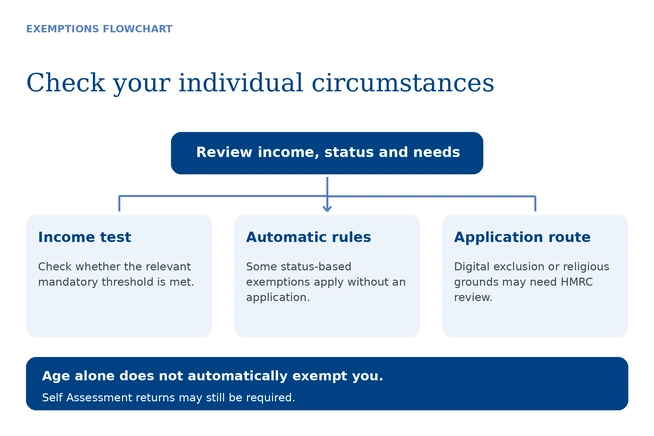
Depending on the circumstances, exemptions may arise because of:
Age alone does not automatically exempt someone from MTD.
Making Tax Digital for Income Tax operates under a newer penalty regime covering late submissions and late payments.
The system generally works through penalty points.
For taxpayers required to submit quarterly updates, the normal threshold is four penalty points.
When the relevant threshold is reached, a £200 penalty may apply, with further penalties for subsequent missed obligations while the threshold remains reached.
HMRC is not awarding late-submission penalty points for quarterly updates relating to the 2026/27 tax year.
However, this does not mean the quarterly updates are optional.
They must still be completed, and the transitional treatment does not remove penalties associated with late annual tax returns or late tax payments.
Late payment penalties operate separately from quarterly submission penalties.
They are calculated by reference to overdue tax and the applicable rules, rather than quarterly reporting penalty points.
The rates and initial grace periods depend on the tax year and circumstances. Late payment interest may also apply.
Taxpayers should therefore avoid assuming that the first-year quarterly filing relaxation protects them from all MTD-related penalties.
For full details, consult HMRC’s MTD for Income Tax penalty guidance.
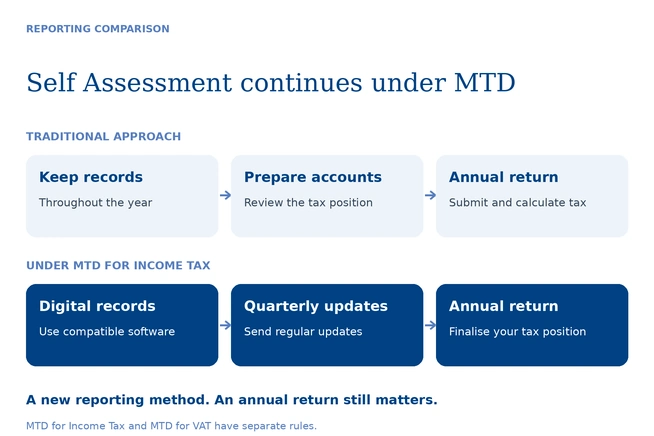
MTD changes the way affected taxpayers complete Self Assessment, but it does not eliminate the annual reporting and tax calculation process.
Under the traditional approach, a sole trader or landlord might maintain records throughout the year and submit one annual tax return.
Under MTD, eligible taxpayers maintain specified digital records, submit quarterly updates and complete their annual tax return using compatible software.
There are also important differences between MTD for Income Tax and MTD for VAT.
| MTD for Income Tax | MTD for VAT |
|---|---|
| Applies to eligible sole traders and landlords | Applies to VAT-registered businesses |
| Eligibility is based on qualifying income and other conditions | Linked to VAT registration |
| Reports self-employment and property income and expenses | Reports VAT information |
| Requires quarterly updates and an annual tax return | Requires VAT returns for prescribed VAT periods |
| Uses compatible Income Tax reporting software | Uses MTD-compatible VAT software |
Being compliant with MTD for VAT does not automatically mean you are ready for MTD for Income Tax.
A VAT-registered sole trader may need to meet both sets of obligations.
Whether you are already within the regime or due to join in April 2027 or April 2028, preparation should focus on the practical responsibilities you will have throughout the tax year.
Review the relevant Self Assessment return and calculate your combined qualifying income.
Do not rely entirely on receiving a letter from HMRC.
Identify each self-employment and property income source and establish which activities require separate digital records or quarterly reporting.
Where registration is required, follow HMRC’s process and connect the relevant software.
Your accountant can assist through the appropriate agent authorisation arrangements.
Create a reliable timetable for recording transactions, reviewing information and submitting updates.
If you are already in the 2026/27 mandatory cohort and have not completed earlier reporting, address outstanding obligations promptly rather than waiting until the annual tax return deadline.
Consider how MTD interacts with other taxable income, property ownership, capital allowances, business expenses and annual tax planning.
Digital bookkeeping is a compliance requirement, but correctly calculating your Income Tax remains equally important.
Making Tax Digital affects taxpayers in different ways. Our specialist guidance covers the most important practical questions in greater detail.
Learn how HMRC assesses qualifying income, when different taxpayer groups must join MTD and what to do before your mandatory start date.
Further reading:
Quarterly Updates, Filing Deadlines and Annual Tax Returns
Understand what quarterly updates contain, how cumulative reporting works, what happens when deadlines are missed and how the annual tax return is completed.
Further reading:
Making Tax Digital for Landlords and Sole Traders
Explore the treatment of jointly owned property, multiple businesses, UK and overseas rental income, allowable expenses and other common reporting situations.
Our specialist articles examine how the general MTD rules apply to individual circumstances, particularly where more than one income source is involved.
Software, Digital Bookkeeping and Compliance
Compare different software arrangements, understand digital record requirements and learn how to manage compliance risks.
Further reading:
Our knowledge centre will continue to expand as further guidance, practical reporting experience and future MTD implementation stages develop.
The greatest practical risk with Making Tax Digital is treating software adoption as the same thing as tax compliance.
An accounting system may be capable of submitting quarterly updates, but it cannot independently determine whether every transaction has been categorised correctly, every allowable relief has been considered or the taxpayer’s full annual income has been reported.
Several points deserve particular attention.
The most effective approach is to use MTD as an opportunity to improve financial record-keeping, while retaining the professional tax review needed to ensure that the correct amount of tax is calculated and reported.
MTD for Income Tax is HMRC’s digital reporting system for eligible sole traders and landlords. It requires digital income and expense records, cumulative quarterly updates and an annual tax return through compatible software. It changes the reporting process rather than creating a new tax.
MTD eligibility is generally based on gross qualifying income from self-employment and property, before expenses. It is not based on taxable profit. A taxpayer can therefore exceed the MTD threshold even where allowable costs significantly reduce their taxable income.
Individual landlords must use MTD for Income Tax when their qualifying income exceeds the relevant threshold and they meet the applicable conditions. Their share of jointly owned rental income can count, as can relevant overseas property income. The number of properties alone does not determine eligibility.
Yes, spreadsheets can form part of a compliant MTD arrangement when connected to suitable compatible software. Excel alone will not necessarily meet all the record-keeping and submission requirements. The full software arrangement must support your relevant quarterly updates and annual tax return.
No. MTD requires quarterly reporting, not compulsory quarterly Income Tax payments. Existing Self Assessment payment deadlines, including payments on account where applicable, remain relevant.
You should correct your digital records as soon as you become aware of an error. Because quarterly updates are cumulative, the corrected amounts can generally be included in a later update without separately resubmitting every earlier quarterly report. Annual tax return corrections have separate requirements.
No. Pension income, employment earnings, dividends and savings interest generally do not count towards the qualifying income threshold. However, these income sources may still need to be included when completing the annual tax return.
Yes. Certain taxpayers qualify for automatic exemptions, while others may apply because digital record-keeping and electronic communications are not reasonably practicable in their circumstances. Exemptions depend on specific HMRC rules; being older or unfamiliar with technology does not automatically qualify someone.
An accountant is not legally compulsory. However, professional assistance can be valuable where you have multiple income sources, rental properties, unfamiliar accounting software or complex year-end adjustments. An authorised accountant can help manage your MTD registration, digital records, quarterly updates and annual return.
This guide reflects the UK MTD for Income Tax rules and published HMRC guidance reviewed on 9 October 2026. Tax treatment depends on individual circumstances, and the legislation and administrative guidance may change.

Subscribe to our newsletter to receive our weekly feed.

69-71 Lambeth Walk London SE11 6DX
Monday – Friday 9:00 am – 5:30 pm
Subscribe to our newsletter
Follow us
Download from
Services
DROP US A LINE
Copyright 2024 Naail & Co | Designed by Orion Global Consulting. | Naail & Co is the trading name of Naail & Co Ltd | Company registration number 08606377 | VAT registration number 170 3380 31


